-
When can the relative pronoun in an attributive clause be omitted
An attributive (relative) clause is essentially an adjective that modifies a noun. Looking at the tree structure of the sentence, any attributive clause can be split into two sentences.
eg: The cat that is eating an apple has a cute head.
Split here:

Notice that here that plays the role of the subject of the clause
eg: The cat that I bought has a cute head.
Split here:
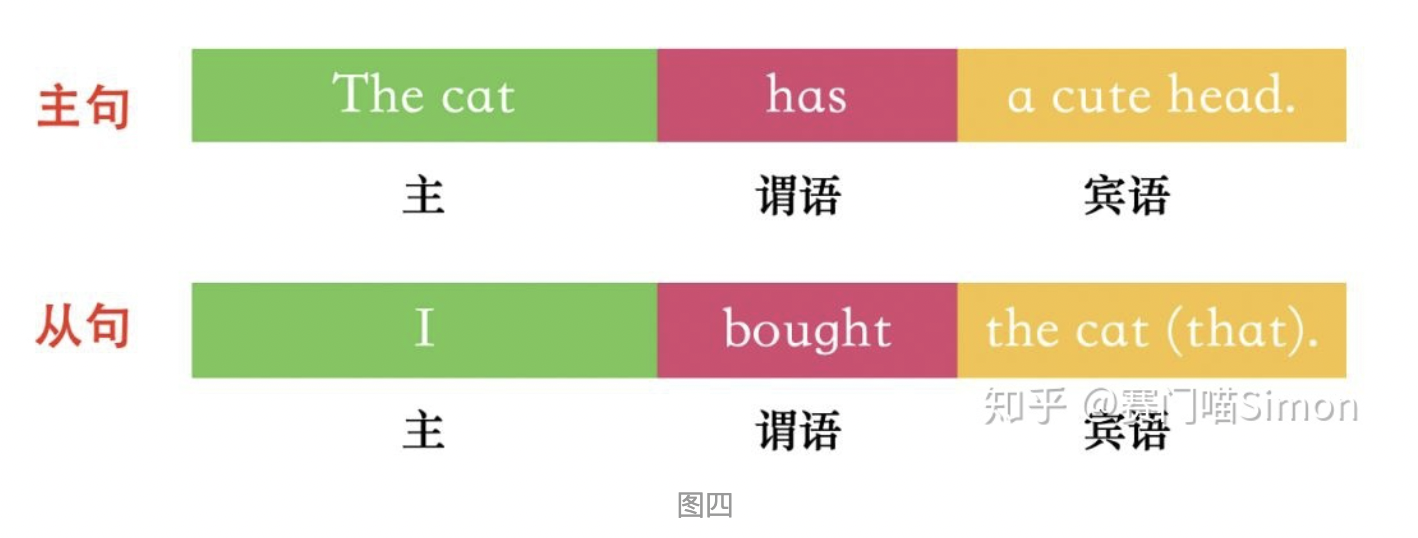
Notice that here that is the object of the clause, so it can be omitted
summary:
that can be omitted only when it is the object of the clause; otherwise it cannot
The cat that is eating an apple has a cute head.
The cat I bought has a cute head.
Note: this rule also applies to attributive clauses with who and which as the relative pronoun.
eg: The man who once saved my life is speaking.
eg: The man whom you saw on the street once saved my life.
Here who can be replaced by whom because it is the object; going further, whom can be omitted, because this is an attributive clause and whom is its object
eg: The man you saw on the street once saved my life.
How to tell
If the relative pronoun (that, which, who) is directly followed by a verb, it is the subject and cannot be omitted. If it is not followed by a verb, it can be omitted.
eg: The picture which caused the sensation is on exhibition.
(which is directly followed by the verb caused and is the subject of the clause, so it cannot be omitted)
eg: The picture that I drew last year is on exhibition.
(that is not directly followed by a verb, so that can be omitted)
Attributive clauses vs. noun clauses
A noun clause is a clause that functions as a noun in a sentence. A noun clause works like a noun phrase: in a complex sentence it can serve as the subject, object, predicative, appositive, object of a preposition, and so on. Depending on its grammatical function in the sentence, a noun clause is therefore called a subject clause, object clause, predicative clause or appositive clause.
First, an attributive clause has an antecedent, and the antecedent can be put back into the clause to make the clause complete;
Second, a noun clause works like a noun phrase and can serve as the subject, object, appositive, etc. in a complex sentence, with different grammatical functions;
Third, a noun clause is equivalent to a noun, whereas an attributive clause is equivalent to an adjective that modifies or restricts a noun or pronoun;
Fourth, an attributive clause only acts as a modifier, so the sentence is still complete if it is removed, whereas a noun clause is a core part of the sentence and cannot be removed.