- Temporary objects
Temporary objects
#include<iostream>

class temporary{
public:
    temporary(){
            std::cout << "temporary ctor" <<std::endl;
    }
    ~temporary(){
        std::cout << "destory"  <<std::endl;
    }
    void fun(){
        std::cout << "This is function output"  <<std::endl;
    }

};
int main(){

    temporary ().fun();
    return 0;
}
output:
temporary ctor
This is function output
destory
- A temporary object is created when you create an unnamed non-heap object, i.e. an anonymous object
Integer inte= Integer(5); //initialize an object with an unnamed temporary object
- When a constructor acts as an implicit type conversion, a temporary object is created and passed to the function as the argument.
class Integer
{
public:
    Integer(int i):m_val(i){}
    ~Integer(){}
private:
    int m_val;
};

void testFunc(Integer itgr)
{
    //do something
}

int  i = 10;
testFunc(i);

A temporary object is created and passed as the argument to testFunc.
- When a function returns an object, a temporary object is created: it is constructed by the copy constructor with the returned object as the argument.
Integer Func()
{
    Integer itgr;
    return itgr;
}

int main()
{
    Integer in;
    in = Func();
}
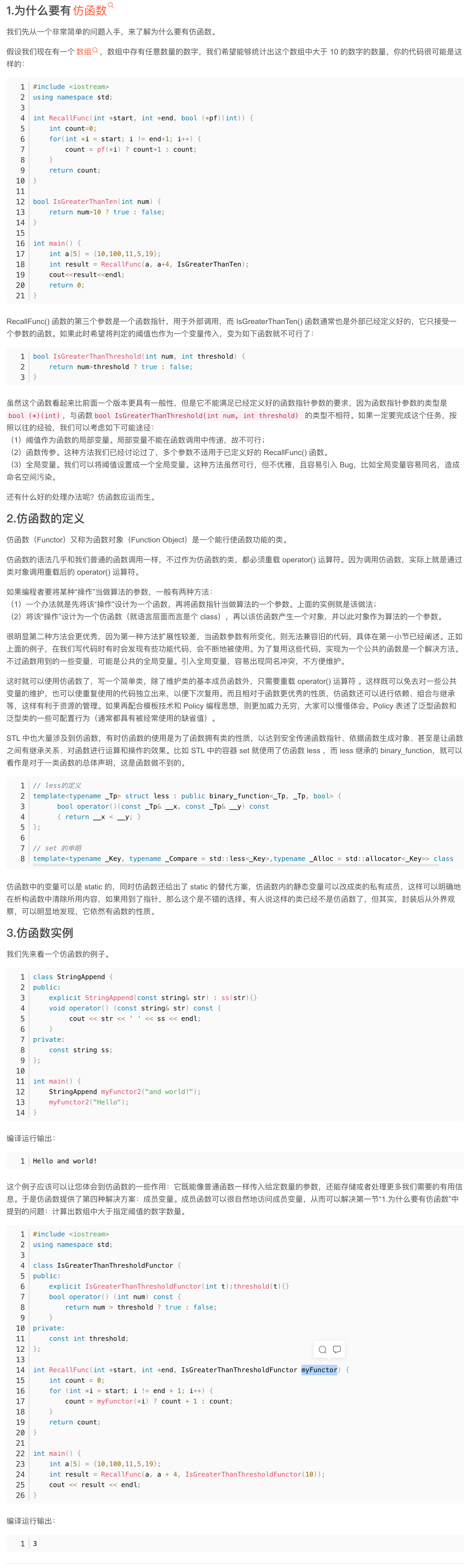
Why we need function-like class?
- An instance of the class can be passed around as an argument (the class can be changed at any time without affecting other classes or functions)
- The standard library contains many functors, and they inherit from various curious base classes